
Comparison to ZX81
Jupiter Ace vs ZX81
A lot of people discover the Jupiter Ace by asking a simple question: is it basically a ZX81? The short answer is no. They are related enough to compare usefully, but different enough that the Ace earns its own lane — especially once you factor in Forth, dedicated screen and character RAM, and a more discrete video design.
JUPITER ACE VS ZX81
SHARED DNA: YES
SAME MACHINE: NO
FORTH VS BASIC
> COMPARE _
Same general era, same broad class of machine, but very different personalities once you start programming them.
The short answer
The Ace looks like a cousin of the ZX81, but it is not just a rebadged Sinclair
The Jupiter Ace and Sinclair ZX81 share a great deal of cultural DNA: both are British, monochrome, Z80-based, TV-and-cassette microcomputers with tiny stock RAM and a fascination with doing a lot from very little. But the Ace diverges in three big ways: it boots into Forth rather than BASIC, it provides dedicated screen and character RAM instead of the ZX81's ULA-driven display scheme, and it includes a built-in buzzer where the stock ZX81 has no sound hardware.
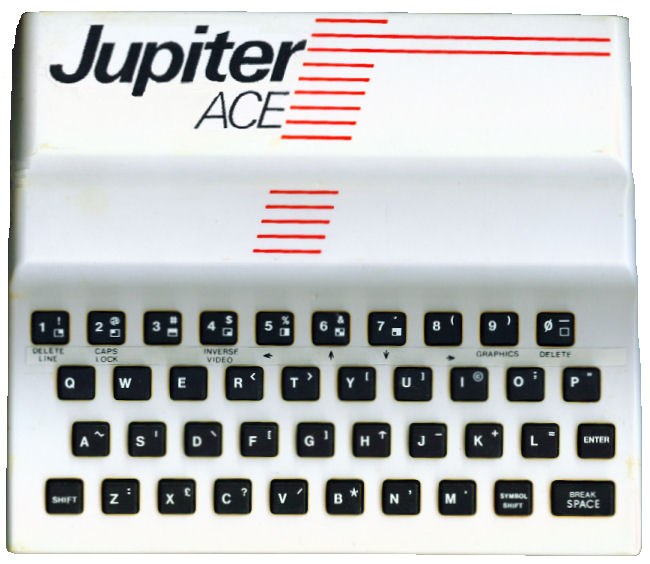
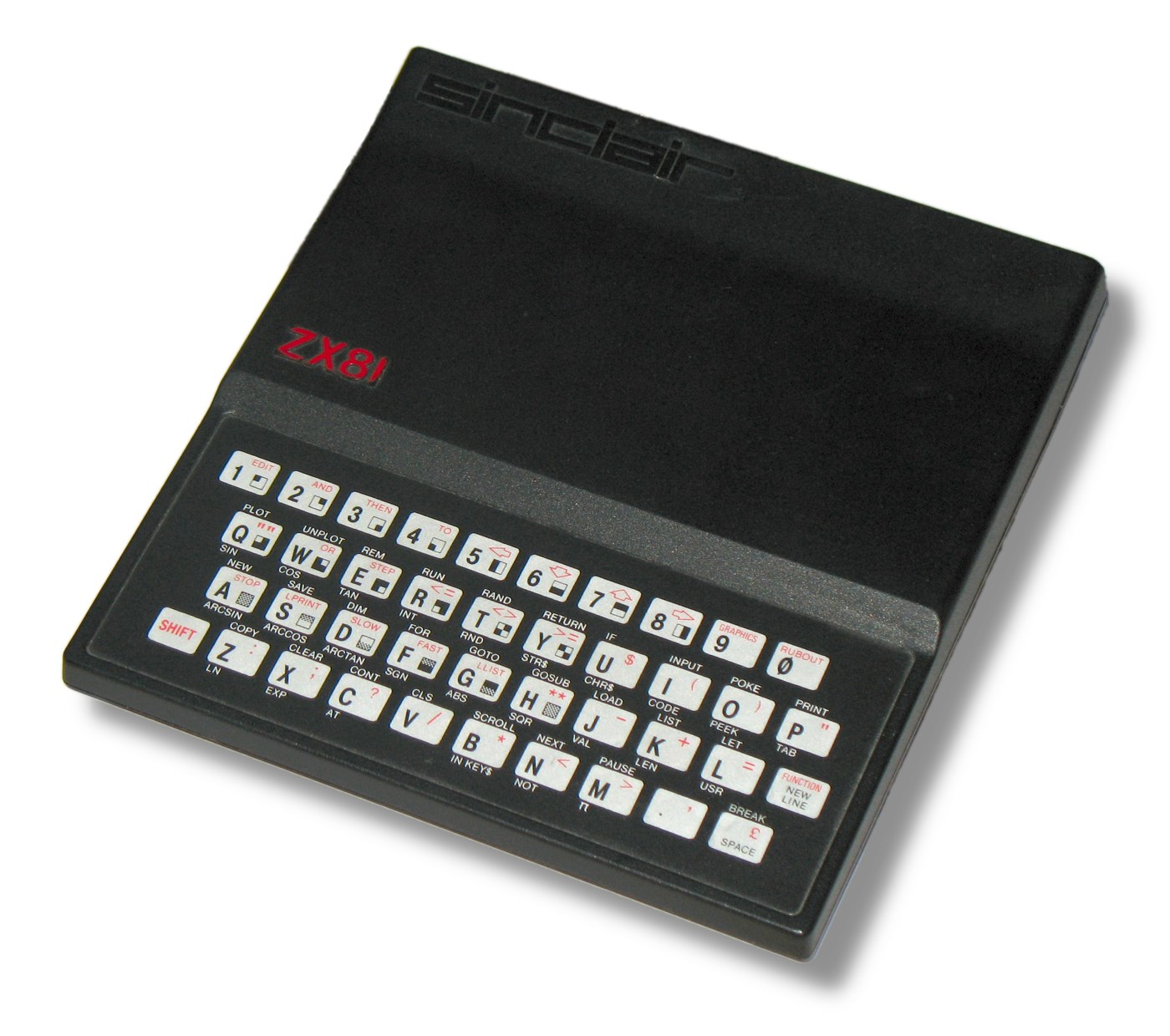
Spec comparison
Jupiter Ace vs ZX81
| Area | Jupiter Ace | Sinclair ZX81 |
|---|---|---|
| CPU | Z80A at 3.25 MHz | Z80A or compatible CPU at 3.25 MHz |
| Built-in language | Ace Forth | Sinclair BASIC |
| ROM | 8 KB | 8 KB |
| Base RAM | 3 KB total fitted as standard, with the practical user-working area smaller than that headline figure suggests | 1 KB fitted as standard, very often expanded with a 16 KB RAM pack |
| Display | 32 × 24 monochrome character display; 128 redefinable characters; semigraphic style roughly around 64 × 48 | 32 × 24 text display; block graphics around 64 × 48; fixed ROM character set |
| Video architecture | Dedicated screen RAM and dedicated character RAM, plus discrete TTL logic and mirrored areas with CPU/video priority differences | ULA-driven display logic; in SLOW mode the machine gives up a lot of effective CPU time to keep the picture on screen |
| Keyboard | 40-key rubber keyboard with auto-repeat | 40-key membrane keyboard |
| Sound | Single-channel internal buzzer, CPU-driven | No built-in sound |
| Storage | 1500-baud cassette via EAR and MIC | Approx. 300 bps cassette |
| Expansion | Main edge connector plus secondary video-oriented connector | Main rear expansion slot, best known for RAM packs and wobble-prone add-ons |
| General feel | More programmer-tinkerer's machine, especially if Forth appeals | More immediately familiar to casual nostalgia because BASIC is the default language |
Shared DNA
Why the two machines get compared so often
1. They come from overlapping talent
Jupiter Cantab was formed by Steven Vickers and Richard Altwasser after their Sinclair work. That family resemblance is real: the Ace sits in the same British early-1980s engineering neighborhood as the ZX81 and Spectrum even when the implementation details differ.
2. Both are austere monochrome TV micros
Each machine expects a domestic TV, uses cassette for storage, ships with a 40-key keyboard, and squeezes a surprising amount out of a 3.25 MHz Z80-class design. The ritual of booting, typing and loading feels instantly related.
3. Both live in the world of tiny default RAM
The ZX81's 1 KB and the Ace's 3 KB are both small enough to shape the personality of the machine. Expansion was not an indulgence; it was often what made the computer feel fully usable.
4. Both make the hardware visible
Neither machine hides its limitations. Display compromises, keyboard quirks, cassette timing and memory budgets are part of the experience rather than something the system politely abstracts away.
The real differences
Where the Jupiter Ace meaningfully parts company with the ZX81
Language: Forth vs BASIC
This is the biggest conceptual break. The ZX81 meets users in Sinclair BASIC, a language many hobbyists still recognise instantly. The Ace instead asks them to think in Forth: stack operations, reusable words and reverse-polish style. That was both its greatest strength and its biggest commercial risk.
Video system
The ZX81's famous SLOW mode interleaves computation with display generation, so visible output costs effective CPU time. The Ace instead keeps dedicated video and character RAM and uses discrete logic to fetch screen codes and glyph rows, making it feel more straightforwardly memory-mapped.
Graphics style
The ZX81 is mainly associated with block graphics and fixed ROM-defined characters. The Ace still looks character-based, but because all 128 characters are redefinable in RAM it can build more flexible semigraphic tricks while keeping text and custom glyph work on screen at the same time.
Sound and I/O
Stock for stock, the Ace is the richer machine here: built-in buzzer, BEEP support, faster cassette behaviour, and an additional rear connector intended for video-oriented expansion. A bare ZX81 is quieter and more stripped down.
Forth in plain English
How Forth differs from BASIC on a machine like this
For many visitors this is the key question. The Jupiter Ace did not fail because its hardware looked alien; it struggled because it asked ordinary home users to meet an ordinary-looking machine through an unusual language.
BASIC tends to read like simple instructions
BASIC usually feels like a sequence of explicit commands and statements. On the ZX81 you tend to think in terms of variables, line numbers, PRINT statements, FOR/NEXT loops and program flow that reads in a fairly plain left-to-right way.
Forth tends to feel like building a toolkit
Forth is stack-based and dictionary-driven. Instead of writing one long linear program, you define small reusable words, then combine those words into larger words. The language is compact, fast and close to the machine, but much less immediately intuitive to someone expecting BASIC.
Arithmetic looks different
In BASIC you normally write expressions in the familiar algebra-like order, such as PRINT 3+4. In Forth you typically push values first and then apply the operator: 3 4 + . That reverse-polish style is elegant once learned, but it is a genuine mental shift.
The payoff is compact, composable code
Because Forth encourages tiny words and direct interaction with the system, it can feel very efficient on a small machine. The downside is obvious: many casual buyers in 1982 wanted a friendly BASIC prompt, not a language that required a fresh way of thinking before the fun began.
BASIC style
10 LET A=3
20 LET B=4
30 PRINT A+B
Forth style
3 4 + .
Why it mattered commercially
The Ace could look familiar in a shop window, but the moment a buyer sat down to use it, the language difference became impossible to ignore. That was brilliant for some enthusiasts and a barrier for many casual buyers.
Why enthusiasts still care
Forth is part of what makes the Ace memorable. It gives the machine a genuinely different identity rather than making it just another tiny British BASIC micro from the same era.
Why emulator users may like it
An emulator lowers the risk. You can try the Ace, experiment with Forth, and decide whether the language fascinates you without needing original hardware, RAM packs or tape setup.
Which would suit you today?
A practical way to think about it
Choose the ZX81 if...
- You want the more immediately familiar language.
- You want the iconic ultra-cheap Sinclair origin story.
- You are nostalgic for the membrane keyboard and BASIC keywords.
Choose the Jupiter Ace if...
- You want the outsider machine.
- You are curious about Forth rather than just old BASIC.
- You like hardware that feels a little more open and a little less custom-chip dependent.
In plain English: the ZX81 is usually the easier conversation starter, but the Jupiter Ace is the machine that rewards a deeper second look. That makes it excellent raw material for a niche emulator site.
Sources and attribution
Primary references used for this comparison
- Jupiter Cantab background and period Ace review material — overlap of personnel and early positioning.
- What is a Jupiter Ace?, PCW bench test and colour-board hardware article — Ace specs, keyboard, sound and video architecture.
- ZX81 technical summary and ZX docs — ZX81 specs, memory arrangement and SLOW-mode video behaviour.
- Jupiter-ace-issue-1.jpg — public-domain Jupiter Ace image.
- Sinclair ZX81.jpg — public-domain ZX81 image.

Page map